

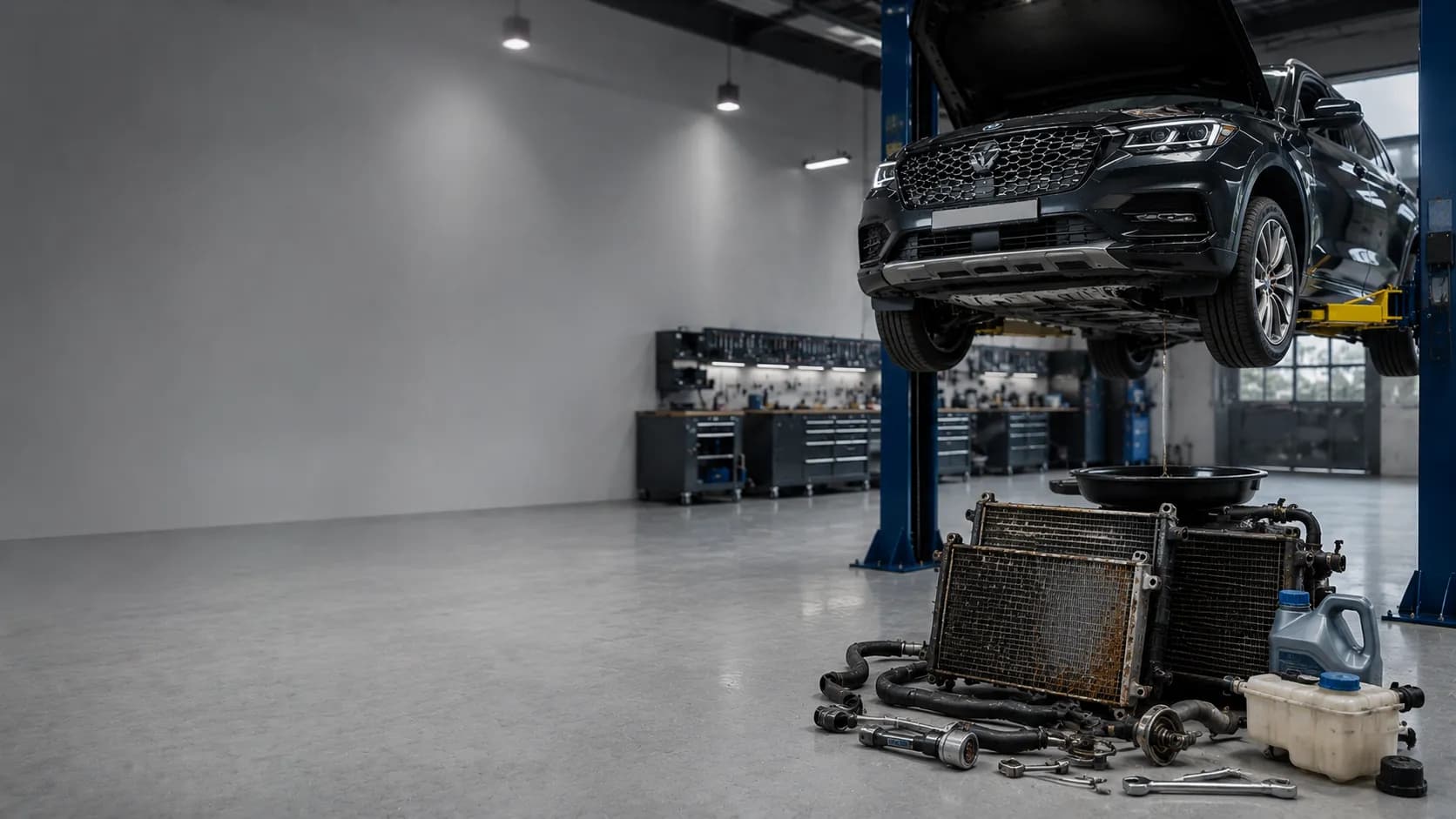
Clermont’s Trusted
Cooling System Repair for European Cars
From the first sign of rising temperature to recurring coolant loss, cooling system issues tend to escalate if ignored. ECC steps in early and handles the complete system across European makes.
European cooling systems do far more than prevent overheating. They regulate turbo temperatures, control emissions systems, protect transmission performance, manage cabin heating, and maintain engine efficiency under constantly changing conditions. ECC repairs the cooling systems European vehicles depend on to stay consistent whether you're sitting in Florida traffic or driving at highway speed.


How We Break Down Car Cooling System Problems at ECC in Clermont
European cooling systems rarely fail as a single component. Electric water pumps, multiple cooling circuits, electronically controlled thermostats, auxiliary pumps, turbo cooling systems, and plastic cooling components all influence overall system behavior. Our inspection focuses on how the entire cooling system performs together.
- Cooling-system pressure testing
- Coolant leak inspection
- Coolant level verification
- Expansion tank inspection
- Water pump evaluation
- Thermostat operation testing
- Radiator inspection
- Cooling fan operation testing
- Cooling hose inspection
- Heater performance evaluation
- Temperature behavior monitoring
- Coolant contamination inspection
- Road testing under operating temperature
- Digital inspection report
How Cooling Problems Usually Develop Across European Makes?
European luxury cars approach cooling in very different ways, depending on performance and design needs. Because of that, the symptoms of a problem can vary a lot from one brand to another.
BMW Cooling System Repair
Plastic Cooling Components & Temperature Management Problems
BMW cooling systems commonly use extensive plastic cooling components and electronically controlled cooling strategies that create predictable aging patterns.
• Electric water pump failures
• Expansion tank leaks
• Coolant hose failures
• Thermostat faults
• Cooling-system warning messages
3 Series | 5 Series | X3 | X5 | X7 | M Models
Mercedes-Benz Cooling System Repair
Multi-Circuit Cooling & Heat Management Problems
Mercedes cooling systems commonly manage engine cooling, cabin comfort, turbo temperatures, and emissions systems simultaneously.
• Thermostat failures
• Coolant leaks
• Auxiliary pump problems
• Cooling fan irregularities
• Temperature fluctuation complaints
C-Class | E-Class | GLC | GLE | S-Class | AMG Models
Audi Cooling System Repair
Water Pump & Thermostat Housing Problems
Audi cooling systems commonly package multiple cooling components together, making small failures influence larger system behavior.
• Water pump failures
• Thermostat housing leaks
• Coolant loss complaints
• Temperature fluctuations
• Expansion tank problems
A3-A8 | Q3-Q8 | S / RS Models
Volkswagen Cooling System Repair
Coolant Loss & Temperature Complaints
Volkswagen cooling complaints commonly appear gradually through small coolant loss or changing operating temperatures.
• Water pump leaks
• Coolant consumption complaints
• Thermostat failures
• Cooling warning messages
• Temperature irregularities
Golf | GTI | Jetta | Tiguan | Atlas
Porsche Cooling System Repair
Performance Cooling & Heat Management Problems
Performance packaging creates different cooling demands where heat management becomes more critical.
• Coolant pipe leaks
• Water pump failures
• High-temperature complaints
• Coolant loss
• Performance cooling concerns
911 | Cayenne | Macan | Panamera
Land Rover Cooling System Repair
Heavy Load Cooling Problems
Large SUVs place additional demand on cooling systems because of weight, towing, and larger engine configurations.
• Cooling-system leaks
• Expansion tank failures
• Temperature increases under load
• Thermostat problems
• Cooling fan failures
Range Rover | Defender | Discovery | Sport
Volvo Cooling System Repair
Temperature Stability Problems
Volvo cooling complaints commonly appear through changing operating temperatures and coolant-system leaks.
• Coolant leaks
• Temperature fluctuations
• Expansion tank concerns
• Thermostat failures
• Cooling warnings
XC40 | XC60 | XC90 | S60 | S90
MINI Cooling System Repair
Turbo Cooling & Compact Packaging Problems
Compact engine packaging creates different cooling challenges because heat management becomes more concentrated.
• Water pump failures
• Coolant leaks
• Turbo heat concerns
• Thermostat faults
• Cooling warning messages
Cooper | Cooper S | JCW | Countryman
Jaguar Cooling System Repair
Heat Management & Luxury Performance Problems
Jaguar cooling complaints commonly involve heat-management behavior across performance-oriented drivetrains.
• Coolant leaks
• Water pump failures
• Temperature fluctuations
• Cooling warnings
• Expansion tank concerns
XF | XE | F-PACE | F-TYPE
FIAT Cooling System Repair
Compact Turbo Cooling Problems
Small turbocharged engines create different cooling demands during daily driving.
• Coolant loss complaints
• Water pump issues
• Thermostat faults
• Temperature changes
• Cooling warnings
500 | Abarth | 500X | 124 Spider
What This Service Covers
Why a Minor Cooling Issue Can Quickly Become a Major Repair?
European cooling systems use specific coolant formulations — BMW blue coolant, Mercedes pink coolant, and VW/Audi G13 purple coolant are not interchangeable. Using the wrong coolant type causes chemical reactions that corrode internal components and degrade seals.
We service the full cooling system using the correct manufacturer-specified coolant and inspect all components — water pump, thermostat, radiator, hoses, and expansion tank — for wear and leaks.
Signs You Need This Service
- Temperature gauge running higher than normal
- Low coolant warning light
- Coolant leak visible under the vehicle (often sweet smelling)
- White steam or white exhaust smoke
- Heater not producing warm air
Service Details
BMW and Mini water pumps have a known failure pattern around 60,000–80,000 miles. If yours hasn't been replaced and you're approaching that mileage, we recommend proactive replacement — a failed water pump causes rapid overheating and potential head gasket damage within minutes.
How European Car Care Evaluates Cooling System Performance and Temperature Control
Understand When The Vehicle Changes Temperature Behavior
We identify whether the problem appears during traffic, highway driving, idling, heavy load, hot weather, or normal commuting conditions.
Evaluate Cooling Performance During Operation
We evaluate operating temperatures, fan behavior, coolant circulation, heater performance, and overall cooling-system consistency.
Inspect Cooling Components Under Pressure
Cooling systems are pressure tested to identify leaks, weak components, and areas losing coolant.
Inspect Components Responsible For Temperature Control
Water pumps, thermostats, radiators, expansion tanks, hoses, fans, and related components are inspected.
Separate Cooling Problems From Temperature Sensor Problems
Some complaints originate from sensors, control systems, or electronics rather than actual cooling failure.
Repair Components & Verify Cooling Performance
After repairs, temperatures and cooling behavior are re-evaluated.
Deliver Findings & Recommendations
Receive clear findings explaining what changed in cooling performance and what repairs are recommended.
Cooling System Repair for European Cars We Work On in
Clermont, FL
Under the hood, every European vehicle manages heat in its own way. Tight engine bays, turbocharged setups, and complex temperature control systems all change the equation. ECC works with how each one is built.
What European Vehicle Owners Say About Their Cooling System Repair Experience At ECC
Amazing service and even better people. They helped my son with his car and treated him like family. It’s hard to find a shop you can truly trust, but this is one of them. We’re very thankful and highly recommend them!

Great price, Professional, honest, and dependable. Great service, clear communication, and quality work. It’s refreshing to find a mechanic shop you can actually trust. I’ll definitely be coming back and recommending them to others. Highly recommend giving them a try!
I am so glad I found European Car Care They are incredibly honest, knowledgeable, and provide fair, transparent pricing. They didn't try to overcharge me for unnecessary services. The work was done quickly and professionally. Highly recommend them for anyone looking for a reliable mechanic!
What Changed About Your Vehicle's
Temperature Behavior?
Coolant loss? Temperature warnings? Sweet smells? Cooling fans running excessively? Rising temperatures during traffic? Tell us what changed because cooling problems usually follow patterns.
Why European Car Cooling Problems Usually Involve
More Than One Component?
Familiarity With European Cooling Architectures
Cooling systems vary dramatically depending on manufacturer strategy
Experience With Electronic Cooling Systems
Modern water pumps, thermostats, and fans behave differently than older systems
Understanding Of Multi-Circuit Cooling Designs
Many European platforms manage multiple cooling systems simultaneously
Experience With Heat Management Problems
Cooling complaints often appear only under specific operating conditions
Focus On Cooling Behavior Rather Than Guesswork
Small cooling-system changes often reveal larger problems
Clear Findings Before Repairs
Understand what changed before approving repairs

European cooling systems commonly leak in places drivers never actually see. Coolant may seep from a water pump onto hot engine components and evaporate immediately. Some BMW and Audi platforms develop slow leaks around thermostat housings, turbo coolant lines, or plastic cooling flanges that only appear once the system reaches operating temperature and pressure.
Your cooling system works very differently at 70 MPH than it does sitting on Highway 50 traffic in the middle of a Florida afternoon. At speed, airflow helps cool the system naturally. During traffic, the entire cooling system depends heavily on fans, coolant circulation, and electronic temperature management. That's why many European vehicles behave perfectly on the highway but begin struggling at red lights.
Many European vehicles continue managing heat even after the engine is turned off. Turbocharged BMW, Audi, Mercedes, and Porsche platforms commonly keep fans running to pull heat away from turbochargers, engine bays, and coolant systems after shutdown. If the fans run unusually long or excessively loud, however, the vehicle may be compensating for a cooling-system issue.
Absolutely. European manufacturers program cooling systems very aggressively because overheating modern turbocharged engines becomes expensive very quickly. It's common for a BMW, Mercedes, or Audi to trigger coolant warnings long before the temperature gauge actually reaches dangerous levels.
Modern European engines constantly adjust operating temperature depending on driving conditions, fuel efficiency targets, emissions demands, and turbocharger heat. Electric water pumps allow the vehicle to control coolant flow much more precisely than older belt-driven systems ever could.
A sweet coolant smell usually means coolant is escaping somewhere the driver can't easily see. Small leaks often land on hot engine surfaces and evaporate before dripping onto the ground. On many European platforms, drivers smell coolant weeks before they ever notice visible coolant loss.
Rarely. Modern European cooling systems involve water pumps, thermostats, cooling fans, expansion tanks, sensors, auxiliary pumps, turbo cooling circuits, shutters, and electronic controls all working together. A vehicle can overheat even when the radiator itself is perfectly fine.
That depends heavily on when the problem appears. A visible coolant leak may be found quickly, while temperature increases that only happen during traffic, highway driving, towing, or hotter weather often require longer evaluation because the system must be tested under the same conditions creating the complaint.